Health, Science, and Technology
Chemistry

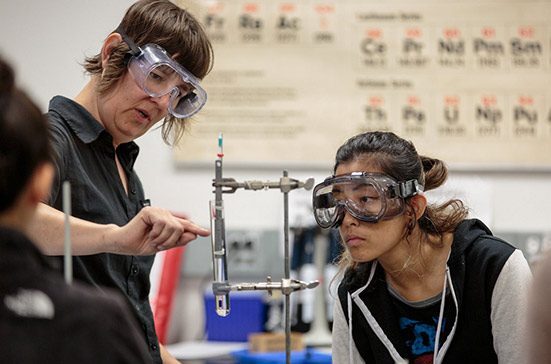
Chemistry addresses the fundamental nature of substances and the changes these substances undergo. For example, what is caffeine? How does caffeine affect your brain? How can we detect caffeine and determine how much is in coffee, tea, or your blood? What chemical reactions can be carried out to synthesize caffeine in the laboratory?
What You Will Learn
Chemistry addresses the fundamental nature of substances and the changes that substances undergo. Students learn problem-solving skills rooted in the scientific worldview. Specifically, you will learn about the chemical aspects of everyday life, enabling you to understand the chemical foundations of the environment, energy, disease (causes and prevention), and the chemical basis of nutrition. The study of chemistry helps you understand the fundamentals controlling the interactions of elements and molecules, which form the basis for our world and the universe. Knowledge of the discipline enables you to practice the protocols and techniques for working safely with chemicals. Modern civilization is based on chemistry and its effects on the environment and ourselves. Some of the consequences are considered better than others, and studying chemistry allows us to search for alternatives that may be practical or feasible.
Modern civilization is based on energy obtained primarily from burning carbon and hydrocarbons, with the result that carbon dioxide levels in our atmosphere have been steadily increasing since the Industrial Revolution. What are the alternatives? Is the hydrogen economy practical or feasible? What about nuclear fission and nuclear fusion reactors?
Our mission includes:
- Preparing students for transfer to four-year institutions and for careers in the sciences and in the health industry.
- Stimulating curiosity about what stuff is made of, how it behaves, and how substances are used in technology.
- Providing undergraduate research opportunities that are not available anywhere else.
Recommended Course Sequence
For Science Majors:
- Chem 1A – 1st Semester General Chemistry (Math 203 and Chem 30A are prerequisites).
- Chem 1B – 2nd Semester General Chemistry (Chem 1A is a prerequisite).
- Chem 12A – 1st Semester Organic Chemistry (Offered at Merritt, Laney, or BCC).
- Chem 12B – 2nd Semester Organic Chemistry (Offered at Merritt, Laney, or BCC).
For Allied Health Majors:
- Chem 30A – Introductory General Chemistry (Math 201 is a prerequisite).
- Chem 30B – Introductory Organic and Biochemistry (Chem 30A is a prerequisite).
What can I do with a degree in Chemistry?
Careers in chemistry include analytical chemist, biotechnologist, biochemist, chemical engineer, dietitian, environmental chemist, food and drug inspector, forensic chemist, geochemist, health professional, pharmacist, professor, and many others. Doctors and nurses often have undergraduate degrees in chemistry.
Degrees & Certificates
Contact Information
Peter Olds
Faculty
epolds@peralta.edu
Eileen Clifford
Faculty
eclifford@peralta.edu
Jacob Schlegel
Faculty
jschlegel@peralta.edu
Alex Madonik
Faculty
amadonik@peralta.edu